Tuesday, 16 July 2024

Teenage Pregnancies Soar as Climate Induced Floods Uproot More Families in Kasese District

Diana Taremwa Karakire

Kasese District-Uganda


                   Glacial fed river Nyamwamba has been bursting it's banks more frequently in recent years 2020  Photo Source: NewVision

Kasese district in Western Uganda has recently gained notoriety for its deadly floods blamed on severe weather events in the region. But, there is also a new phenomenon, the once copper-rich district has one of the highest rates of teenage pregnancy in the country, with 40% of girls pregnant by the age of 18 as of 2022, and climate change has become one of the drivers.


 Rehema Alema Namale uses a megaphone to summon teenage mothers in Muhokya camp -for people displaced by flooding in Kasese district.Image by Diana Taremwa Karakire

 On a hot and humid day in Muhokya internally displaced people’s camp,located about 10 km south of Kasese, young teenage mothers gather in a ram-shackled classroom,they have been summoned by the chairperson incharge of the settlement via  a megaphone.

One by one, they make their way out of makeshift houses made of mud and tattered tarpaulins. In the tiny room, 12- to 16-year-old mothers breastfeed their babies, while others are heavily pregnant.

“Most of the teenagers here often fall pregnant due to lack of sex education,” says Rehema Alema Namale, who was appointed chairperson of the camp.

I count, there are roughly 15 teenage mothers, demonstrating how crises can escalate. After being uprooted from the safety of their homes by catastrophic floods brought on by River Nyamwamba in 2020, they were pushed into a settlement where they have fallen victim to child-to-child sex, rape, child marriage and prostitution.

16-year-old Triphen Muhindo is sprawled out on a mat with her one-year-old baby, Biira, sitting on her lap. Biira is crying and tugging at her mother's blouse. In response, Muhindo clicks her tongue. Muhindo is a primary five school dropout. She lives with her parents and got pregnant while in the camp.


               16 year old Triphen Muhindo and her baby - Muhokya Camp- Kasese district

“I needed basic needs like clothes and pads.My parents couldn't provide them. So I decided to get a boyfriend and ended up pregnant,” said Muhindo ,who was prematurely plunged into the world of adults.

For 15 year old Mary Kabubo, life has never been the same ever since she discovered she was pregnant.She misses school ; she used to study at Bulembeya Secondary school, which was destroyed by floods. She was working at a restaurant in Kasese town where a man approached her and asked her to be his girlfriend.


15-year-old Mary Kabubo, life has never been the same ever since she discovered she was pregnant.
She misses school

"I was happy. I thought my fortunes had turned. He always gave me money that I used to buy food for my four younger siblings who were always at home hungry," said Kabubo. However, once he discovered that she was pregnant, he vanished. Now, she spends her days hiding inside their makeshift home.

Winnie Masika , now 16, gave into the advances of a man she met in the market who offered her Ugx 100,000.She saw a chance to get the same shoes her friends were wearing.“I didn’t know I could get pregnant from having sexual intercourse,” she said, breast-feeding seven-month-old Eliza. When Masika fell pregnant, she was flabbergasted. 


 Winnie Masika , now 16, gave into the advances of a man she met in the market who offered her Ugx 100,000

 The camp has only one midwife who is unavailable most of the time. Pregnant mothers in most cases give birth from from inside the barely hygienic houses. Just next to the camp is a Muhokya health center three but the teenage mothers say that nurses at the hospital refuse to attend to them.


 Muhokya Heath Centre three . Teenage mothers say that nurses at the hospital refuse to attend to them


“ They treat us like outsiders and don’t want to attend to us. Sometimes they ask for past medical records that we lost during the floods or money that we don’t have,” said Masika.

 Conditions in Muhokya camp are notoriously poor. Basic sanitation facilities, such as hand washing facilities and toilets, are lacking , which contributes to the risk of disease spreading. Namale says that parents are concerned about the increase in teenage pregnancies in the camp.

“Life here is hard, especially raising girls in this condition.We can’t stay home and protect them. We shall go hungry!”


Makeshift houses made of mud and tattered tarpaulins dot the area-Muhokya camp
 For work, most camp denizens travel to Kasese to do casual labor while others work as farm hands in gardens.

 “We cannot till the land here, it’s not ours.We depend on donations from government and well wishers , sometimes they come ,sometimes they don’t,” said Namale.

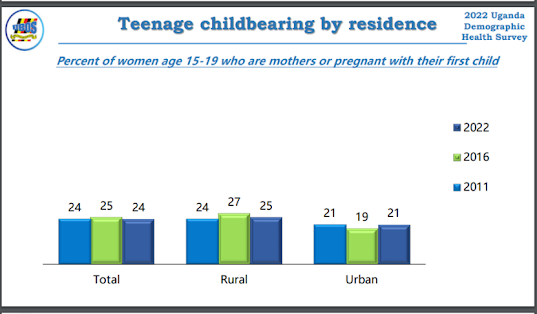
 For Kasese district whose teenage pregnancy rates are among the highest in the country, climate related disasters have become another significant driving factor .The Uganda Demographic and Health survey 2022,shows that the district still has high numbers of pregnant young girls below the age of 18 years,with over 7,000 teenage pregnancies.Among the causes cited include; lack of sex education,school dropout, child marriages and inadequate access to sexual reproductive services tailored for young people.At 24%, Uganda still has one of the highest rates of teenage pregnancy East Africa.


 Teenage childbearing is higher in rural areas (25%) than in urban areas (21%). Adolescents engage in sex due to poverty, lack of education, domestic violence, and peer pressure.

 Faizo Muhindo, the Kasese District Probation and Social Welfare Officer, sympathizes with Namale and the other women and girls at Muhokya camp, but he says that the district lacks resources to cater to all of their needs.

“Government through the office of the prime minister has been planning to compensate them by buying for them land for relocation , but I don’t know why this is taking long,” he said.

For more than three years, the people in Muhokya camp have been waiting for a resettlement package promised by various government officials. Until the government allocates resources to compensate and resettle them, there’s not much they can do but wait.

Climate change is a reality in Uganda.Droughts, extreme heat, flooding, landslides and increased exposure to disease are all linked to climate change .Data from the Uganda Meteorological Department indicates that since the 1960s, average temperatures have increased by about 1.3° Celsius a phenomenon that has caused glaciers on the Rwenzori ranges -also known as the mountains of the moon to melt and recede.UNESCO says that a third of the 50 World Heritage sites that contain glaciers, including the Rwenzoris, will disappear by 2050 no matter what actions are taken to slow global warming.


 River Nyamwamba has been carrying more water downstream wreaking havoc on communities in the lowlands.

 As the air that hangs above the Rwenzori ranges gets warmer, melting glaciers have led to overflow and flooding of major rivers in Kasese particularly River Nyamwamba which emerges from the mountains on it’s way to L.George in the Albertine rift.

In recent times,Nyamwamba has been carrying more water downstream wreaking havoc on communities in the lowlands.Several lives have been lost ,gardens and homes destroyed.In may the river burst its banks twice.This situation is exacerbated by the degradation of fragile ecosystems through deforestation and illicit sand mining, on mountain slopes and riverbanks.


The 2020 floods that uprooted Namale and her neighbors were the worst on record, according to a 2022 Kasese district disaster report.These affected 9,916 households, 48947 people, with about 80% being children and major infrastructure notably, Kilembe Mines hospital.


Kilembe Mines Hospital has not been operational ever since it was affected by floods in 2020

For Namale, who once lived in Nyamwamba division-at the foot of Mt. Rwenzori, memories of what happened are still fresh. Her once towering 4 bed roomed house was destroyed by the floods, shattering her dreams of sheltering her 9 children. She now owes a community bank around 5million Uganda shillings which she had borrowed to set up the house. She frowns her face as she recounts events leading up to the disaster.
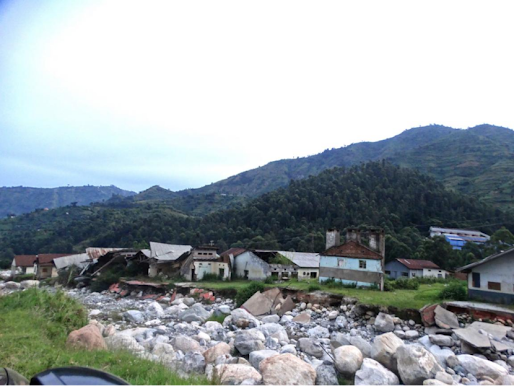


The May 2020 Nyamwamba floods were the worst on record affecting around 9,916 households and 48947 people.


 “We woke up to people screaming loudly and running everywhere. Too much water carrying huge stones was gushing from the mountains,” she recalls. “We grabbed a few belongings and started running. It’s a miracle that we survived.”


Worries of more destruction and deaths from floods and landslides have prompted government to formulate a relocation plan to move and resettle communities from at-risk mountainous areas of Mt Rwenzori, however, implementation of the plan remains slow due to resource constraints.

Other interventions have included desilting and restoration of the river Nyamwamba catchment to contain flooding.Desilting is a type of dredging activity that focuses on removing sediment, silt, and debris from the bottom of water bodies like rivers to make them deeper and less prone to overflowing.Two years ago, government secured funding from the World Bank to desilt 5.4 kilometers of the critical catchment areas of the river.


 Several lives were lost and property destroyed in Nyamwamba division -Kasese district

 According to United Nations Population Fund Uganda,women and girls are among the worst affected during climate-induced disasters .These often disrupt education and access to health services increasing unplanned pregnancies .lack of education and health services means that girls understanding of their own sexual and reproductive health is also limited.In cases where people are displaced forced into camps, sexual violence,child marriages and other harmful practices also tend to rise.

Uganda’s Climate change Act 2021 is gender sensitive.It advocates for gender mainstreaming in climate change adaptation and mitigation programmes but implementation remains a challenge as the gender-ed effects of climate disasters are often disregarded during response and recovery.

“These environment disasters affect everybody but there are subgroups that need special attention,” said Irene Twongeirwe technical lead -climate at Women for Green Economies. “Any kind of response has to prioritize women and girls sexual and reproductive health needs”


The subject of climate change and how to assist victims of climate change through the Loss and Damage fund was a dominant topic at the COP28 Climate Conference in Dubai last year. Beatrice Anywar, Uganda’s environment minister noted that climate change is now the main driver of human displacement across East and the horn of Africa, and urged developed countries to step up funding for displacement projects.


“We must address the climate-induced migrations, especially among poor nations like Uganda,” she said. “As a country with an open refugee policy, it’s a shame that we don’t have enough funds to look after our own people”

The World Bank projects that 11 percent of the population could move within Uganda because of slow onset climate factors, without concrete climate and development action by 2050.


 Latest data from the International Organisation for Migration Uganda shows that as of March 2024, 426 people representing 91 households have been internally displaced by climate-induced disasters including heavy storms/hailstorms and floods.Source:IOM


“Government should integrate migration issues into policies and action plans on climate change at the national and local levels ,” said Edwin Mumbere,director at Center for Citizens Conserving Environment & Management, a local non-profit in Kasese that is supporting communities living on mountain slopes to adopt sustainable farming practices.  “International support can also help offset the financial burden of loss and damage experienced by communities in Kasese”

Thursday, 16 May 2024


Protesters outside the Uganda High Commission in London urging Uganda’s president not to sign a law targeting LGBT organisations . Credit:
Dinendra Haria / Alamy Stock Photo.

Gender and Sexuality Amidst the Climate Crisis In Uganda.

Discriminatory gender and social norms ensure women and sexual and gender minorities in Uganda face disproportionate impacts from climate change and have the fewest resources to cope. Both groups experience discrimination, systemic violence, restricted access and ownership of land, lower income and fewer opportunities, while minority communities also face persecution, social stigma and discriminatory laws. All of these factors drive higher vulnerability, reduced adaptation and mitigation capability, and further marginalises already marginalised people.


In eastern Uganda, particularly in the districts of Bududa and Mbale, persistent extreme weather conditions, such as frequent floods and landslides, have claimed hundreds of lives and property. In August 2022, flash flooding in Mbale district killed at least 29 people and displaced over 5,600 others. Marginalised women and gender and sexual diverse people in these areas are particularly at risk when disaster strikes.


Women and Climate Change

According to the UN, 80% of people displaced by climate change are women. Their roles as primary caregivers and providers of food and fuel make them more vulnerable when flooding and drought occur. The Uganda Bureau of Statistics (UBOS) notes that women are responsible for 70-80% of agricultural production, as well as nutrition and food security at the family level. Bad and extreme weather conditions - which are increasing - or periods of prolonged drought mean that Ugandan women's traditional responsibilities become increasingly uncertain and dangerous. In rural areas this means girls and women must make more frequent and longer journeys in search of food, firewood and water which may lead to less time for any educational activities and attending training, less time to complete other household and family responsibilities, and makes them vulnerable to sexual assault and domestic violence (see: United Nations Development Programme). 


Women in Uganda own less land and have less secure land rights than men despite their crucial role in agriculture and food production. Uganda has a comprehensive land policy that grants all adults equal rights to own and co-own land, however in 2011 UBOS showed that as many as 61.3% of women do not own land and are only given access to it through husbands and male family members. Most land in Uganda is effectively preserved through customary arrangements that restrict women's land ownership. This limits women's ability to adapt to or mitigate the effects of climate change, while the day-to-day impacts of climate change make them more vulnerable to a diverse range of issues including gender-based violence and relying on precarious livelihoods. Important efforts are being made to address some of these challenges. For example, Kwatanisa Women Farmers Group, an organisation founded by 10 women in 2007, works to address issues of  food preservation, reforestation and afforestation aimed at reducing the effects of climate disasters on rural women.


The LGBTQ+ Community and Climate Change

Homophobic and transphobic laws and attitudes are widespread in Uganda, and LGBTQ+ people face persecution. The 1950 Penal Code prohibits same-sex sexual activity, in 2005 a constitution amendment was signed to prevent same-sex couples from marrying, and the 2019 Sexual Offences Bill sought to further criminalise same-sex relationships. Although the President did not give assent to the Bill, the fact it passed Parliament in May 2021 shows the continued hostility towards the LGBTQ+ community by those in positions of power. Due to discrimination and exclusion from social and family  networks, sexual and gender diverse people live in constant danger of harassment and abuse. These issues are  intensified as a result of relocation, insecurity, and loss of livelihoods caused by climate-related disasters and the implications of changing seasons and weather patterns. LGBTQ+ people frequently struggle economically in the face of harsh weather patterns, due both to a lack of resources and how competition for scarce resources often benefits those with higher social standing. Climate change also negatively impacts when and how many crops can be grown in a season, which impacts LGBTQ+ people harder, as they often have less access to land or places to turn for support. When landslides and floods hit mountainous areas of east and western Uganda, LGBTQ+ people cannot access the same assistance and relief as others because they are viewed as criminals.


Lack of recognition of same sex couples under Ugandan law exposes such couples to the risk of not enjoying equal protection of rights in case of environmental disasters. For example, land acquisition and resettlement practices have evolved to entitle couples to have rights to compensation before their land is given away. The same rights are not extended to same sex couples. Meanwhile, assistance programmes tend to have specific ideas of ‘the family’ and gender, which sexual and gender diverse people do not match, often leading to their exclusion.


Despite these challenges, the LGBTQ+ community in Uganda have taken the initiative to inform, organise and act in response to climate change through training programmes and workshops. For example, in 2022 Rights 4 Her Uganda carried out a dialogue with LBQ womxn on climate change and environmental issues, and their relationship to bodily autonomy and gender-based violence. The organisation also runs environmental academies to increase knowledge and understanding of climate change within the LGBTQ+ community. Ahead of COP27 in Egypt, Rights 4 Her Uganda’s Executive Director called for greater inclusion of LGBTQ+ people in climate change discussions and programmes in Uganda and beyond.


How is the Government responding?

In recent  years, the Government has increased efforts to mitigate and adapt to climate change: the Climate Change Department was established within the Ministry of Water and Environment to oversee and enforce climate action, and the National Climate Change Act 2021 hopes to help enable Uganda to meet its commitments under the 2015 Paris Agreement. The Government was intentional about gathering women's perspectives to inform the new Climate Change Act. Through meetings organised for women by the Ministry of Water and Environment, women's organisations such as the Uganda Women's Network were involved in reviewing and commenting on the draft law. As a result, gender issues and women's rights are mentioned in the Climate Change Act. For example, it calls for efforts on gender mainstreaming in climate change adaptation and mitigation programmes. However, the challenge is in putting law and policy into action. Vulnerable groups of people and the gendered effects of climate change are often disregarded during implementation. Additional efforts must be made to ensure that financial and technical resources are available for effective implementation and gender mainstreaming in climate change initiatives. These must acknowledge differing levels of vulnerability and ability to mitigate the impacts of climate change, while also promoting equal rights, opportunities, and treatment for all.


Monday, 26 February 2024

Total Energies' Uganda Oil Project Advances Despite Opposition From Climate Campaigners


 Total Energies is pressing on with it’s $10 billion oil project, in Uganda’s lake Albertine Rift Basin despite rising criticism from climate activists and environmentalists concerned about the oil project's emissions profile and environmental impact.

Environmentalists argue that oil production will shift a large portion of the Uganda’s energy needs toward carbon-emitting fossil fuels making it more difficult for the country to adapt to and mitigate the effects of the climate change reality.

Jobi Rii-5 well pad construction site in Murchison Falls National Park ,Tilenga project area operated by Total Energies in Uganda’s Albertine Graben Region.


Total Energies has begun to invest in renewable energy sources such as solar power and undertaking several initiatives aimed at tackling climate change and lowering it’s carbon foot print but activists say the company must do more to fight climate change.

Last year, the company signed a solar project agreement with the Ministry of Energy and Mineral Development for possible deployment of 120 MW of solar energy.This is part of the company’s commitment to develop 1GW of renewable energy in Uganda by 2030.

“The solar energy projects are part of Total Energies global multi-energy strategy and climate ambition to reach net zero emissions by 2050,”says Philippe Groueix, the General Manager of Total Energies Uganda.

In addition to renewable energy initiatives, Groueix says that Total Energies is working with government to use its existing infrastructure in Uganda to assist in the implementation of e-mobility infrastructure. The company owns and operates over 200 petrol stations, which it intends to upgrade to include charging stations for electric motorcycles and cars.

  A Resettlement house  constructed by Total Energies  installed with Solar panels in Ngwedo sub-county, Buliisa district 


"We plan to not only produce oil, but also to become a key player in renewable energy in Uganda to address the twin challenges of energy poverty and lower emissions," Groueix said.

However, environmentalists remain concerned about the environmental impact of Total Energies oil projects and continue to advocate for their total abandonment in favour of renewable energy ,based on the Paris Agreement on climate, which aims for a 50 per cent cut in emissions by 2030 and net zero by 2050.

“These oil projects,will worsen the impacts of climate change that are already affecting poor people in Uganda and Africa, especially those depending on their lands to live.What is needed is gross reductions of emissions,” said Juliette Renaud senior campaigner at Friends of the Earth France.

Globally, there is growing recognition of the need to transition to more sustainable energy sources and reduce reliance on fossil fuels in order to cut greenhouse gas emissions and stay below 1.5 degrees celsius compared to pre-industrial levels.According to the UN, coal, oil, and gas are by far the most significant contributors to global climate change, accounting for more than 75% of world greenhouse gas emissions and almost 90% of total carbon dioxide emissions. The sun's heat is trapped as more greenhouse gas emissions from dirty fuels blanket the earth.

Total Energies operates the Tilenga and EACOP oil projects. Tilenga covers the remote districts of Buliisa, Hoima, Kikuube, and Nwoya near the Murchison Falls National Park. It consists of six oil fields and is expected to have 400 wells drilled in 31 locations. It will also house an industrial area, support camps, a central processing facility, and feeder pipelines.

The EACOP entails construction of a buried 1,443 km oil pipeline between the town of Kabaale in Uganda and the port of Tanga in Tanzania. The pipeline includes six pumping stations and a heat tracing system.


                                             A map showing the EACOP route

The pipeline has the capacity of transporting 216,000bopd and is operated by the EACOP Ltd whose shareholders are Total Energies  62%, Uganda National Oil Company 15%, China’s CNOOC 8% and the Tanzania Petroleum Development Corporation 15%.

A report released in October 2022,by the US-based Climate Accountability Institute CIA states that the EACOP will produce vast amounts of carbon dioxide that will result in 379m tonnes of climate-heating pollution over a period of 25 years, the project’s shelf-life.This is far greater than estimates in the EACOP's environmental impact assessment reports , which CIA notes that accounted for a mere 1.8 percent of the project's emissions and did not take into account downstream emissions such as transporting oil from the pipeline to global markets.The report further notes that in the years of peak oil flow, the associated emissions would be more than double those of Uganda and Tanzania in 2020.


A chart showing the full project emissions from construction to end use, 25-yr life source,Climate Accountability Institute


“The scale of TotalEnergies’ crude oil extraction and transport through the EACOP pipeline can not be mitigated by the company’s initiative to develop renewable energy sources and plant trees,”said Rick Heede ,author of the report.

Last year ,the European Union’s Parliament passed a resolution urging the TotalEnergies and government of Uganda to abandon the EACOP project citing climate destruction and human rights concerns.President Yoweri Museveni responded to this resolution with a twitter post where he stated that Europe's failure to meet its climate goals should not be Africa's problem.  

"We will not allow African progress to be the victim of Europe's failure to meet its own climate goals. It is morally bankrupt for Europeans to expect to take Africa's fossil fuels for their own energy production but refuse to countenance African use of those same fuels for theirs," he said


A well pad Construction site at Kingfisher Development area operated by China’s CNOOC in Kikuube district

Total Energies has launched the Tilenga Biodiversity Program , an initiative aimed at protecting and conserving biodiversity in and around the Tilenga project area.Implementation of this program will include among others protection of 10,000 hectares of natural forest threatened with deforestation and restoration of 1,000 hectares of tropical forest.

“We are mindful of the sensitive context within which we are undertaking our activities. We have thus made a commitment to ensure that we implement action plans designed to produce net positive impact on biodiversity,”Groueix stated in a statement posted on the Total Energies website.

But activists are not persuaded.Some have formed a campaign called #STOPEACOP .They want government and TotalEnergies to halt oil projects in order to demonstrate its commitment to carbon reduction and energy transition.

“Most fossil projects have between 25-30 year life spans .Getting into this type of investment will definitely undermine any safer alternatives and will lock a country on dirty fuel for decades, and potentially leave them with stranded assets,”says Abiud Onyach the STOPEACOP Communications and Digital associate

Total energies also has an ongoing law suit filed in France , where a number of environmental organizations accuse the company of green washing "misleading consumers about its efforts to combat climate change." 

 “Total Energies says they will leave a "net positive impact on biodiversity" but it is part of their green washing. You cannot have a positive impact on biodiversity with oil wells in a natural protected area, and with a pipeline crossing many fragile ecosystems,” says Renaud.

World Bank figures indicate that only 3% of the world's CO2 emissions originate from Africa, the second-largest and second-most populous continent, which is home to around 20% of the world's population.Africa remains the most vulnerable to the effects of climate change, although contributing the least to the climate crisis.


Uganda emits only 0.01% of the world's total carbon emissions, and its per-person emissions of CO2 are likewise quite low at 0.13 tonnes.However, analysts predict that once oil production begins, this will change.


“EACOP intends to implement a number of carbon footprint reduction strategies to reduce greenhouse gas emissions from the operation of the pipeline, these include the complete electrification of pumping stations in Uganda, where grid electricity is primarily produced by hydroelectric plants, and a hybrid power generation solution in Tanzania that involves solar energy from five solar farms that will be installed along the pipeline, ” says Peter Muliisa, the Chief legal and Cooperate affairs for UNOC


Uganda’s GHG Emissions Profile

Climate change is a reality in Uganda.The dramatic reduction in the size of ice caps on the Rwenzori mountains and an increase in the frequency and duration of droughts have both been related to changing climate trends. In August 2022, flash flooding in Mbale district killed at least 29 people and displaced over 5,600 others.


According to the 2022 Uganda Nationally Determined Contributions report submitted to the United Nations Framework Convention on Climate Change, Uganda’s GHG emissions have been on the rise from 53.4 MtCO2e in 2005 to 90.1 MtCO2e in 2015 .

The Land Use and Forestry sector accounts for majority of emissions with 59.5% of the total emissions.Agriculture is the second largest, contributing 26.9%, followed by the energy sector 10.7%and waste 2.3%. The energy sector, which includes transport, power generation, and oil and gas exploration and production, accounts for 10%, with the transportation sub-sector accounting for around 66% of energy sector emissions.

This story was produced with support from the Africa Centre for Media Excellence